頬 筋 ( きょうきん、英:buccinators muscle )
・ 概 要 |
・ 作 用 |
・ イラスト掲載サイ |
|
・ イラスト |
・ 神経 / 脈管 |
||
・ 起始 / 停止 |
・ Wikipedia |

・頭部の表情筋のうち口唇と頬周辺の筋肉の一つで、筋肉の一方が皮膚に付着している皮筋である。

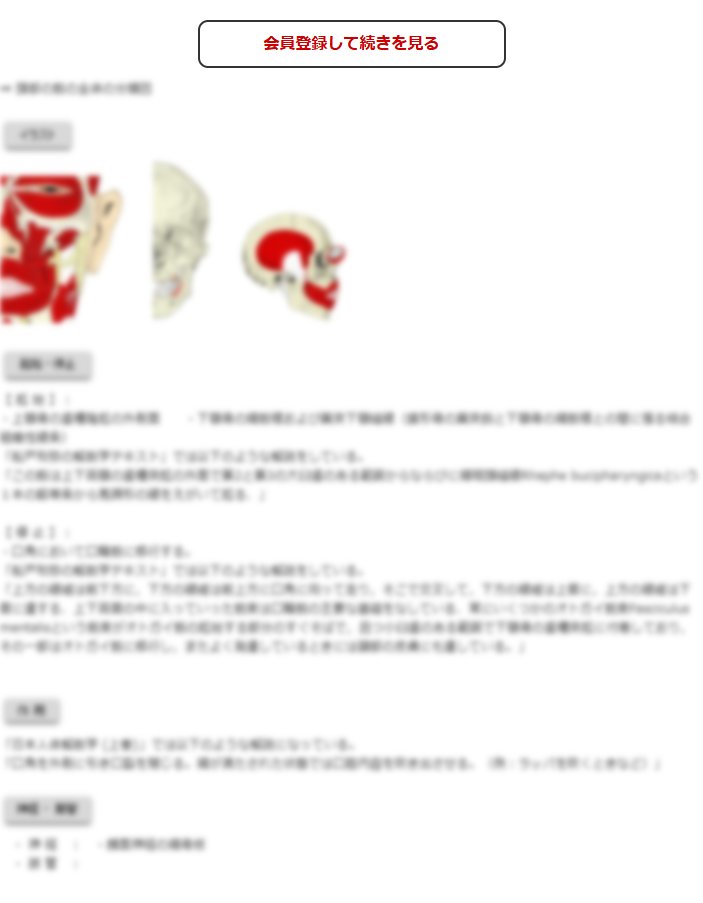

The buccinator (/ˈbʌksɪneɪtər/[2][3]) is a thin quadrilateral muscle occupying the interval between the maxilla and the mandible at the side of the face. It forms the anterior part of the cheek or the lateral wall of the oral cavity.[4]
Structure[edit]
It arises from the outer surfaces of the alveolar processes of the maxilla and mandible, corresponding to the three pairs of molar teeth and in the mandible, it is attached upon the buccinator crest posterior to the third molar;[5] and behind, from the anterior border of the pterygomandibular raphe which separates it from the constrictor pharyngis superior.
The fibers converge toward the angle of the mouth, where the central fibers intersect each other, those from below being continuous with the upper segment of the orbicularis oris, and those from above with the lower segment; the upper and lower fibers are continued forward into the corresponding lip without decussation.
Innervation[edit]
Motor innervation is from the buccal branch of the facial nerve (cranial nerve VII). Sensory innervation is supplied by the buccal branch (one of the muscular branches) of the mandibular part of the trigeminal (cranial nerve V).[6]
Function[edit]
Its purpose is to pull back the angle of the mouth and to flatten the cheek area, which aids in holding the cheek to the teeth during chewing. This action causes the muscle to keep food pushed back on the occlusal surface of the posterior teeth, as when a person chews. By keeping the food in the correct position when chewing, the buccinator assists the muscles of mastication.[4]
It aids whistling and smiling, and in neonates it is used to suckle.
【 語 句 】
・: ・: ・: ・: ・: ・: ・: ・: ・: ・: ・: ・: ・: ・: ・: ・: ・: ・: ・: ・: ・: ・: ・: ・: ・: ・: ・: ・: ・: ・: ・: ・: ・: ・: ・:

・イラストを掲載しているサイト②