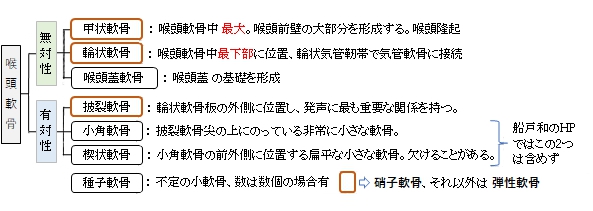
「 The thyroid cartilage is the largest of the nine cartilages that make up the laryngeal skeleton, the cartilage structure in and around the trachea that contains the larynx.
【Structure】
It is composed of two plate-like laminae that fuse on the anterior side of the cartilage to form a peak, called the laryngeal prominence. This prominence is often referred to as the "pomus Adami"or "Adam's apple". The laryngeal prominence is more prominent in adult male than female because of the difference in the size of the angle: 90° in male and 120° in female.
The lip of the thyroid cartilage just superior to the laryngeal prominence is called the superior thyroid notch, while the notch inferior to the thyroid angle is called the inferior thyroid notch.
Its posterior border is elongated both inferiorly and superiorly to form the superior horn of thyroid cartilage and inferior horn of thyroid cartilage.
Thyroid cartilage
【Layers and articulations】
The two laminae that make up the main lateral, surfaces of the thyroid cartilage extend obliquely to cover either side of the trachea. The oblique line marks the superior lateral borders of the thyroid gland.
The posterior edge of each lamina articulates with the cricoid cartilage inferiorly at a joint called the cricothyroid joint.
Movement of the cartilage at this joint produces a change in tension at the vocal folds, which in turn produces variation in voice.
The entire superior edge of the thyroid cartilage is attached to thehyoid bone by the thyrohyoid membrane.
【Function】
The thyroid cartilage forms the bulk of the anterior wall of the larynx, and serves to protect the vocal folds ("vocal cords"), which are located directly behind it.
Changing the angle of the thyroid cartilage relative to the cricoid cartilage changes the pitch.
It also serves as an attachment for several laryngeal muscles.」