下咽頭収縮筋 (かいんとうしゅうしゅくきん、英:inferior constrictor)


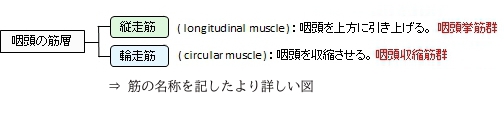
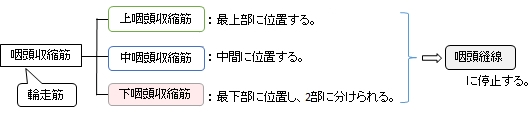
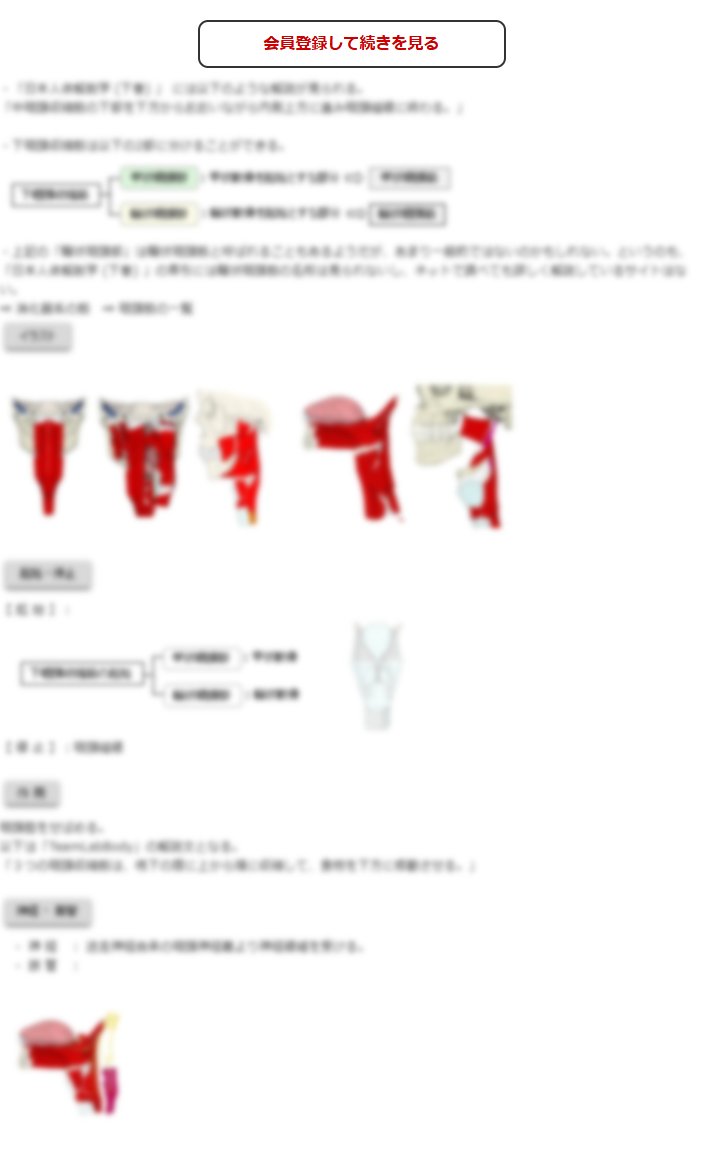

The Inferior pharyngeal constrictor, the thickest of the three constrictors, arises from the sides of the cricoid and thyroid cartilage. Similarly to the superior and middle pharyngeal constrictor muscles, it is innervated by the vagus nerve (cranial nerve X), specifically, by branches from the pharyngeal plexus and by neuronal branches from the recurrent laryngeal nerve.
【Origin and insertion】
The muscle is composed of two parts. The first (and more superior) arising from the thyroid cartilage (thyropharyngeal part) and the second arising from the cricoid cartilage (cricopharyngeal part).
- On the thyroid cartilage it arises from the oblique line on the side of the lamina, from the surface behind this nearly as far as the posterior border and from the inferior cornu.
- From the cricoid cartilage it arises in the interval between the Cricothyreoideus in front, and the articular facet for the inferior cornu of the thyroid cartilage behind.
From these origins the fibers spread backward and medialward to be inserted with the muscle of the opposite side into the fibrous pharyngeal raphe in the posterior median line of the pharynx.
The inferior fibers are horizontal and continuous with the circular fibers of the esophagus; the rest ascend, increasing in obliquity, and overlap the Constrictor medius.
【Action】
As soon as the bolus of food is received in the pharynx, the elevator muscles relax, the pharynx descends, and the constrictors contract upon the bolus, and convey it downward into the esophagus.
【 語 句 】
・cricoid cartilage:輪状軟骨 ・thyroid cartilage:甲状軟骨 ・vagus nerve:迷走神経 ・cranial nerve:脳神経 ・pharyngeal plexus:咽頭神経叢 ・recurrent laryngeal nerve:反回神経 ・thyropharyngeal part:甲状咽頭部 ・cricopharyngeal part:輪状咽頭部 ・lamina:板 ・inferior cornu:下角 ・Cricothyreoideus:? ・articular facet:関節面 ・pharyngeal raphe:咽頭縫線 ・pharynx:咽頭 ・esophagus:食道 ・obliquity:傾斜 ・bolus:塊 ・elevator muscles:挙筋群 ・contract:収縮する ・convey:運ぶ