・「網膜視部」に対して前部(毛様体部・虹彩部)の光を感じない部分を網膜盲部と呼ぶ。
・「生体では硝子様透明、平滑であるが、死後は不透明となりヒダを生じる。」(日本人体解剖学)
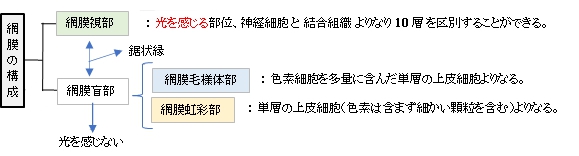
・「生体では硝子様透明、平滑であるが、死後は不透明となりヒダを生じる」(日本人体解剖学)

 この部位の閲覧には会員登録が必要です。

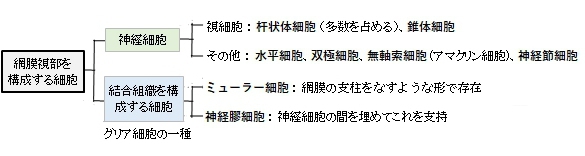
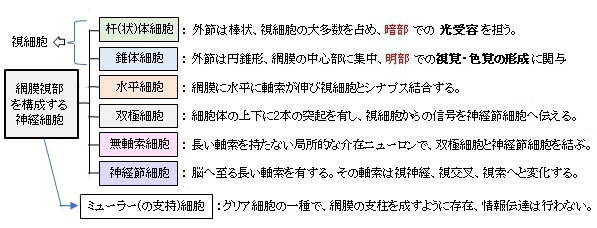
網膜視部に見られる細胞は、大きく情報の伝達を行う神経細胞と結合組織を構成する細胞の2つに分けることができる。
 この部位の閲覧には会員登録が必要です。

「日本人体解剖学」では網膜視部を外方から内方に向かって以下の10層構造としている。

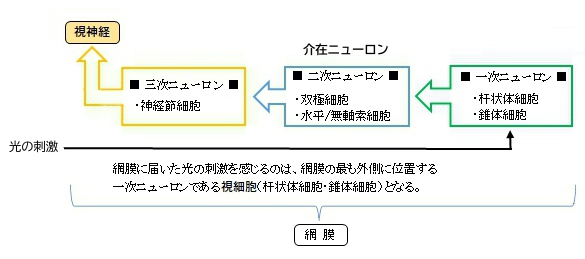
網膜視部に届いた光の刺激は、まず網膜視部の一番外側に位置する一次ニューロンである杆状体細胞および錐体細胞
で感じ取られ、そこから二次ニューロン、そして三次ニューロンへと伝達していく。
 この部位の閲覧には会員登録が必要です。

「 日本人体解剖学 」では以下の3つを網膜の特異な部位としている。
1. 視神経円板 : 眼球を内腔から見たときに視神経が進入する楕円形の部位
2. 黄斑 : 視神経円板の外側に位置する視覚が最も鋭敏な部分
3. 鋸状縁 : 網膜視部と網膜盲部の境界となる非常に薄い部分
 この部位の閲覧には会員登録が必要です。

あ行 |
え |
|
お |
|
か行 |
き |
|
さ行 |
し
|
|
た行 |
ち |
|
な行 |
に |
|
ま行 |
み |
|

以下は「Wikipedia」の「retina」の解説文の一部となる。
□Inverted versus non-inverted retina□
The vertebrate retina is inverted in the sense that the light-sensing cells are in the back of the retina, so that light has to pass through layers of neurons and capillaries before it reaches the photosensitive sections of the rods and cones. The ganglion cells, whose axons form the optic nerve, are at the front of the retina; therefore, the optic nerve must cross through the retina en route to the brain. No photoreceptors are in this region, giving rise to the blind spot. In contrast, in the cephalopod retina, the photoreceptors are in front, with processing neurons and capillaries behind them. Because of this, cephalopods do not have a blind spot.
【 語 句 】
・inverted:逆になった? ・capillary:毛細血管 ・photosensitive:感光性の ・en route to~:~への途中 ・blind spot:盲点 ・cephalapod:(タコ・イカなどの)頭足綱の動物
Although the overlying neural tissue is partly transparent, and the accompanying glial cells have been shown to act as fibre-optic channels to transport photons directly to the photoreceptors, light scattering does occur. Some vertebrates, including humans, have an area of the central retina adapted for high-acuity vision. This area, termed the fovea centralis, is avascular (does not have blood vessels), and has minimal neural tissue in front of the photoreceptors, thereby minimizing light scattering.
【 語 句 】
・transparent: ・glial cell: ・fibre-optic:光ファイバーの ・photon: ・light scattering:光散乱 ・acuity:鋭敏さ ・fovea centralis:中心窩 ・avascular:無血管の
The cephalopods have a non-inverted retina, which is comparable in resolving power to the eyes of many vertebrates. Squid eyes do not have an analog of the vertebrate retinal pigment epithelium (RPE). Although their photoreceptors contain a protein, retinochrome, that recycles retinal and replicates one of the functions of the vertebrate RPE, cephalopod photoreceptors are likely not maintained as well as in vertebrates, and that as a result, the useful lifetime of photoreceptors in invertebrates is much shorter than in vertebrates. Having easily replaced stalk eyes (some lobsters) or retinae (some spiders, such as Deinopis) rarely occurs.
The cephalopod retina does not originate as an outgrowth of the brain, as the vertebrate one does. This difference suggests that vertebrate and cephalopod eyes are not homologous, but have evolved separately.
【 語 句 】
・resolving power:解像力 ・analog:相似器官 ・retinal pigmental epithelium:網膜色素上皮 ・retinochrome:レチノクロム(感光性色素蛋白)) ・replicate:模写する ・stalk:細長い支え ・homologous:相同の ・evolve:進化する
From an evolutionary perspective, a more complex structure such as the inverted retina can generally come about as a consequence of two alternate processes - an advantageous "good" compromise between competing functional limitations, or as a historical maladaptive relic of the convoluted path of organ evolution and transformation. Vision is an important adaptation in higher vertebrates.
A third view of the "inverted" vertebrate eye is that it combines two benefits - the maintenance of the photoreceptors mentioned above, and the reduction in light intensity necessary to avoid blinding the photoreceptors, which are based on the extremely sensitive eyes of the ancestors of modern hagfish (fish that live in very deep, dark water).
【 語 句 】
・perspective:考え方 ・come about:起こる ・consequence:結果、結論 ・alternate:交互の ・compromise:妥協 ・maladaptive:不適応の ・convoluted:回旋状の、入り組んだ ・adaptation:適応 ・hagfish:メクラウナギ
■ 写真やイラストを掲載しているサイト ■
・ イラストや写真を掲載しているサイト-Ⅰ
・ イラストや写真を掲載しているサイト-Ⅱ
・ イラストや写真を掲載しているサイト-Ⅲ
・ イラストや写真を掲載しているサイト-Ⅳ
・ イラストや写真を掲載しているサイト-Ⅴ